
· by Hanna Carolina · 5 min read
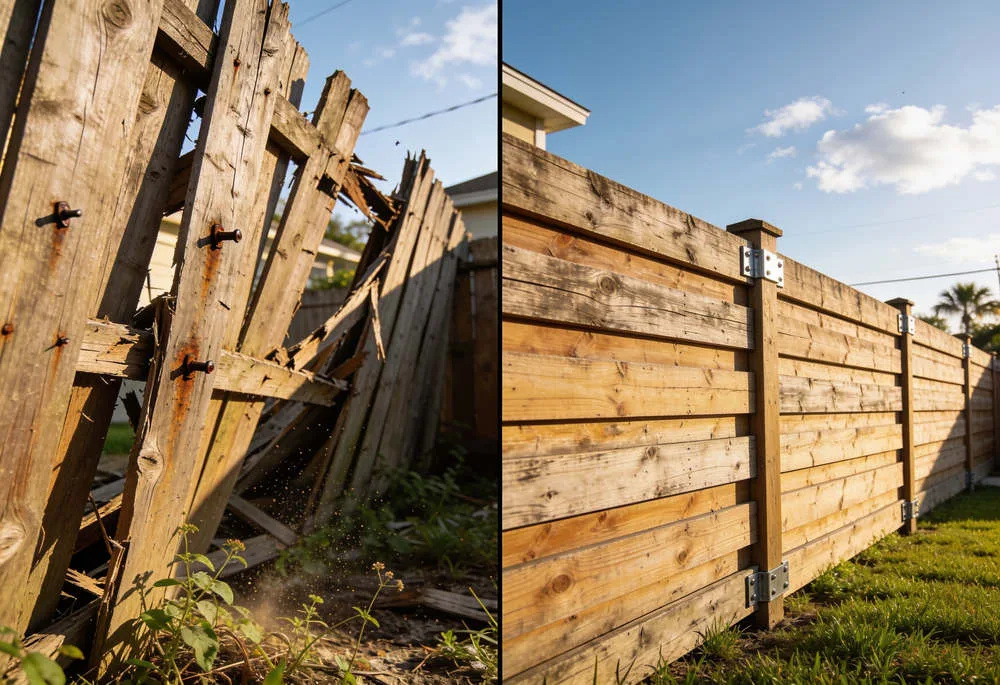
Before you tear out your entire fence, get an honest assessment of what actually needs to go. A leaning section is usually a post problem, not a panel problem. Storm damage is often isolated to one or two sections. Rot on a wood fence tends to concentrate at the base of posts long before it reaches the rails and pickets. Most damaged fences in Orlando can be repaired for significantly less than a full replacement, and the ones that genuinely need to come out are usually obvious once someone who knows what to look for walks the line.
If your fence is leaning, latching wrong, or came through the last storm looking worse than it went in, call Wulff Fence for an honest repair-versus-replace assessment at (407) 745-8635 before you commit to a teardown.
A leaning fence is almost always a post problem
Homeowners in the Conway area and throughout the older residential neighborhoods of southeast Orlando see this regularly: a fence that was perfectly upright for years gradually develops a lean, usually after a wet season or a significant storm. The instinct is to assume the whole fence is failing. In most cases, one or two posts have shifted in the soil, and the panels attached to them followed. The panels themselves are often fine.
Resetting a post in concrete is a repair. It costs a fraction of replacing a fence section. Wulff Fence has worked through enough leaning fences across Central Florida to say they have not found one yet they could not fix. That is not a boast; it is a pattern. The problems that look catastrophic from the driveway are usually localized once you get hands on the posts.
Neighborhoods around the Baldwin Park area deal with a specific version of this because many of the fences there were installed during the community's original development and are now aging together. A fence that has stood for fifteen years with minimal maintenance is going to have post movement. That does not mean the fence is done. It means the posts need attention.
Storm damage: assess the section, not the whole fence
After a storm rolls through the Orlando area, the damage pattern on fences is almost never uniform. One section takes a hit from a falling branch or a neighbor's debris. The rest of the fence is fine. Replacing the whole thing because one section is down is the most common way homeowners overspend on fence work after a storm.
The right question is whether the affected section can be rebuilt to match the existing fence in material, height, and style. In most cases it can. Matching pressure-treated wood is straightforward. Vinyl panel sections are more material-specific but still manageable when the original product line is identifiable. The only scenario that pushes toward full replacement is when a fence has widespread post failure across multiple sections, or when the existing material is so weathered that a repaired section will look noticeably different from the rest.
Rot, hardware failures, and gates that won't close
Rot in a wood fence almost always starts at the post base, where the wood meets the soil and holds moisture. By the time rot is visible on rails or pickets, the post has usually been compromised for a while. The repair window is not gone; a rotted post can be replaced individually without touching the panels it supports. But the earlier you catch it, the less collateral damage there is to work around.
Gate problems are their own category and are almost never a reason to replace a fence. A gate that sags, drags, or refuses to latch has hardware issues: hinge tension, latch position, or frame alignment. These are repairs. The same applies to wrought iron fence installation and repair: surface rust and loose pickets are maintenance items, not replacement triggers, as long as the structural frame is sound.
What responsible fence work looks like before anyone digs
One thing worth knowing before any fence crew breaks ground on your property: underground utilities, irrigation lines, and electrical conduit run through most Orlando yards. A crew that does not get utilities marked before digging is a crew that will eventually nick something and leave you to sort it out. Wulff Fence gets underground utilities marked on every job. If a marked line still gets hit despite that precaution, the utility company repairs it at no cost to you. That step costs nothing and protects you from a problem that is entirely avoidable.
Their workmanship carries a one-year warranty. Materials carry lifetime manufacturer warranties. And they are not a truck-and-a-phone-number operation that is hard to reach once the job is done.
When replacement actually makes sense
Full replacement is the right call when post failure is widespread across the fence line, when the material has reached the end of its functional life, or when the homeowner wants to change material or style entirely. It is also the right call when repair costs approach replacement costs, which a straightforward estimate makes clear. The goal is not to talk anyone out of replacing a fence that needs to go. It is to make sure nobody replaces a fence that did not.
You can learn more about fence installation and repair options on the Wulff Fence site. When you are ready for someone to walk your fence line and give you a straight answer on what it actually needs, call (407) 745-8635 or reach out to Wulff Fence to schedule your assessment.